This page, of periodic instalments, contains summarised accounts of some of the actions and combat operations of Alto Cenepa, a war that is 30 years old and whose history still lives in darkness.
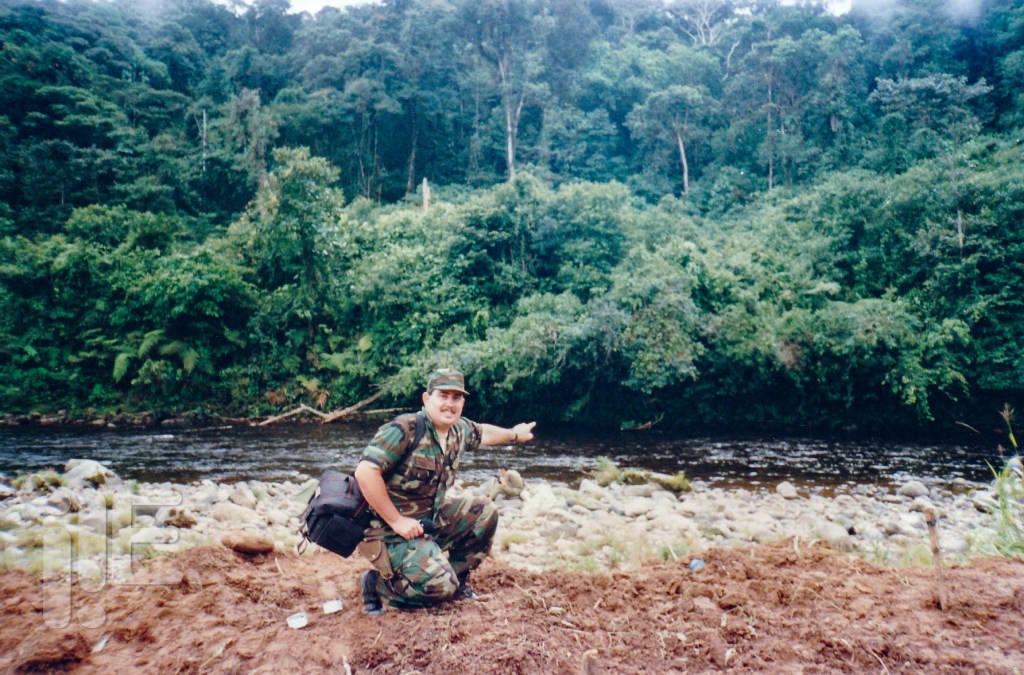
THE GIANTS OF CENEPA
The beginning
Introduction
30 years ago, the most significant military operation in Peru’s history began. A drama that, I have no doubt of pointing out, as a great victory, the end of long controversies and the wanted peace with Ecuadorians.
However, the result of the difficult military operations was described at the time as a «shameful defeat” by «specialists», politicians, and all kinds of characters with opinions (not yet amplified at the time by the non-existent social networks). It must be admitted that not even the military commanders themselves knew how to analyze and assess the consequences of these operations. The fog of war blinded the view of the horizon and distempered the downcast spirits. But evidence of the contrary began to emerge.
The political outcome of the war is very clear. With the efficient intervention of the guarantor countries, Ecuador was cornered by international treaties –something that the Ecuadorian generals never placed in the script of their war of aggression–. Finally, they were forced to sit down at the negotiating table, within the framework of the Rio de Janeiro Protocol of 1941, a legal instrument that they historically wanted to review and deny. It must be admitted that at the end of the twentieth century, International Law was still in good health, unlike what has been happening in the chaos and the current global law of the strongest.
However, the negotiations were difficult and tortuous, often sterile and clumsy. In 1998 another threat of conflict with Ecuador loomed. In anticipation of this, the Fujimori government made a hasty acquisition of weapons (and the controversial Russian made MIG-29 fleet) in anticipation of a new escalation. Finally, former presidents Fujimori and Mahuad were forced, literally, to meet behind closed doors, to reach a definitive solution, leaving behind foreign ministers and diplomats uncapable to reach an agreement.
The Cenepa War was created by a group of politicians who wanted to take advantage of the profits generated by hatred, and by a group of military officers who ended up with Ecuador’s meager economic reserves, acquiring weapons (for which they were even swindled), sending hundreds of brave, forgotten, and deceived soldiers to their deaths. Later, those same generals enjoyed the money and prestige that the failed war brought them, dedicating themselves to the most abject work of the supposed military leader: political ambition and power.
The very costly peace that Peru and Ecuador have achieved has proven to be based on International Law, mutual respect, the freedom and sovereignty of their peoples, on economic and cultural rapprochement and on the knowledge of the absolute truth, which has avoided, until today, repeating the mistakes of the past.
Political and economic situation in 1995
In 1994, Peru reached the highest GDP in its history (12.3% under normal conditions, not because of the pandemic). At that time, the country was emerging as the one with the greatest potential in the region, receiving a lot of foreign investment. Peru was reborn from the ashes of a brutal internal confrontation and the chaotic economic management of the government of Alan García. There was not yet the mining boom, nor the large industries that later flourished, simply, Peruvians began to live and work. After the conflict with Ecuador, GDP fell to only 8.5% and the following year to 2.5%. To what extent did the cost of the conflict affect the national economy? Directly, not much, if one takes into account the cost of mobilization, logistics and the loss of aircraft (most of which reached the limit of their operational life). Indirectly, the costs were very high. The simple fact that the country was plunged into a new conflict (in addition to the internal one) added to the virulent Ecuadorian propaganda and the tendentious internal criticism, ended up scaring away foreign investors. It should be noted that, until 1994, Chilean investments in Peru were not significant. However, in 1995 these arrived massively, 5 billion in that year alone. Is it a coincidence or part of a calculated operation? History and the market maintain comfortable darkness on this matter.
It should be remembered that during the conflict, the Chilean government sold arms to Ecuador. They claim that the negotiation took place in 1994, but the weapons and war supplies arrived in 1995, when the conflict had already broken out. The Foreign Ministry did not denounce this sale firmly enough, so as not to hinder relations with a nation that is the guarantor of the Rio de Janeiro Protocol. In addition to this, Ecuador was negotiating with the Argentine government of Carlos Menem, another arms acquisition. The secret operation of triangulation and transport of Argentine weapons was detected denounced by a Peruvian pilot, former military aviator and patriot. These flights were carried out in February 1995, in the midst of the conflict. The betrayal of the ruler of the sister nation left an unjust moral wound as a legacy. To this day the episode is remembered with bitterness, paradoxically, more in Argentina itself than in Peru. However, the weapons sold by Carlos Menen turned out to be useless, the president defrauded the Ecuadorian military! At the end of the conflict, the deception was discovered, the scandal broke out, and Ecuadorians nicknamed their «victorious» generals as «The Scrap Dealers of the Cenepa». Even General Gallardo, Ecuador’s Minister of Defense, was forced to visit the prison. In Ecuador, the armed forces had enjoyed good prestige and income. Before the conflict broke out, the Ecuadorian Congress had been pushing for rules to privatize military-owned companies that would harm them by taking away their income. These political actions and norms were coincidentally curbed by the war.
In Peru the situation could not be worse. The long fight against terrorists had diverted funds from defense, and the war effort focused almost exclusively on the home front. Although the threat of a new military adventure on the part of Ecuador was always a constant, the «gentlemen’s agreement» and Fujimori’s historic visit seemed to have calmed the warmongering spirits. But the «gentleman’s agreement» would prove to be a futile instrument. In addition to this, the successive governments of Peru had neglected the necessary operation of the Armed Forces, whose equipment was aging and deteriorating rapidly.
A new struggle for the presidency of the republic was added. Although, at the beginning of the conflict, there was a laudable unity of criteria in support of the war effort by politicians and candidates, this was rapidly transformed into criticism and outbursts, which would be pernicious to national objectives. Ecuador’s president, Duran Ballén, accused Fujimori of «instigating the war for electoral purposes.» Immediately, the Peruvian candidates appropriated and used the Ecuadorian argument in Perú. Electoral preferences for Fujimori were very high, followed far behind by his closest contender, Ambassador Javier Pérez de Cuellar. It must be admitted that at that time, Fujimori’s popularity did not require a costly war to achieve reelection. However, Pérez de Cuellar would later say that:
«Peru had lost the battle because President Fujimori had not raised the flag over Tiwinza.»
The innocent but fatal comment would shape political discourse and public opinion, motivated by political interests rather than the truth. The military action was underestimated, the memory of those who gave their lives in the struggle would be muddied and would leave the high command stunned.
The Theatre of Operations
A basic principle, described by Sun Tzu 2500 years ago, is that which refers to the terrain in which one must engage in battle. The Alto Cenepa is a depression of almost virgin jungle, crossed by hills, valleys and rivers, without land communication routes, not suitable for combat operations and against the basic principle of Sun Tzu. If the Ecuadorian hypothesis had been true (Peru as the aggressor), the logical thing to do would have been to choose a flatter terrain, where to deploy the numerical superiority of the Peruvian Armed Forces, the distance from the air bases and the support of the naval force.
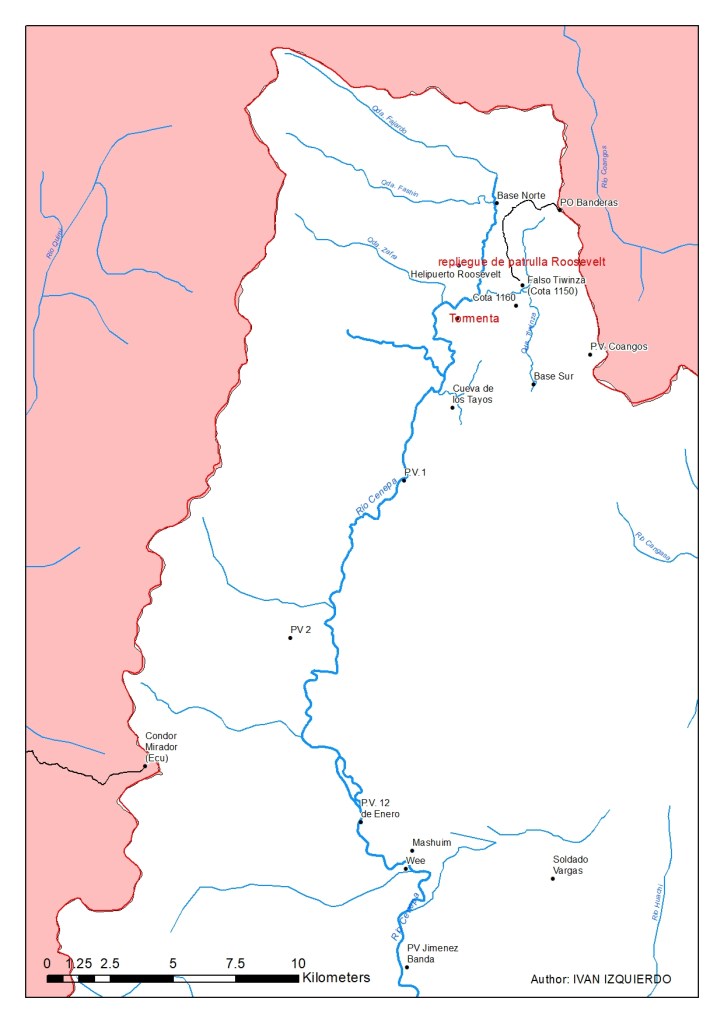
In the Upper Cenepa, Ecuador dominates the heights of the depression with bases surrounding the «finger» that forms the boundary line. From the bases of «Coangos» and «Banderas» it was no more than 5 kilometers to the places they had invaded. This facilitated logistics, artillery cover, and the launching of rockets from «Cóndor Mirador» (a point located to the southwest, towards the rear of the Peruvian positions). The well-known «South Base«, «Cueva de los Tayos» and the various «Tiwinzas» would be easy targets for deadly artillery when they fell into Peruvian hands. In short, the terrain of Alto Cenepa will never favor a force that attacks, but it does so with one that defends itself. The «bases» that Ecuador had created were simple clearings in the forest at levels that allowed for relative defense, easily recreated elsewhere, which constituted the main psychological and media strategy that sought to deceive the entire world. It must be recognized that the Armed Forces of Peru were not prepared to counteract Ecuadorian propaganda by losing on the other battlefront of modern warfare: the press and public opinion (the war for hearts and minds).
The Alto Cenepa Theatre of Operations only allowed the use of light artillery, portable anti-aircraft weapons, infantry and above all, aviation. Operations were supported from the air by transport and attack helicopters. In addition, the basic and fundamental stone: air superiority.
The Air Force used all the material available at the time, aircraft that were already denouncing their obsolescence. The only platform, worthy of modern combat, was the Mirage 2000 aircraft but they lack the support from search and combat radars on the ground. The history of the shady negotiation of these aircraft has been buried in the history of corruption and in the book «High Flying Birds» by the late Senator Carlos Malpica. It explains the negotiations that broke the contract and reduced the number of M-2000 aircraft, from 26 to only 14. They arrived in Peru devoid of equipment and all the weapons necessary for their use… which would prove indispensable in 1995.


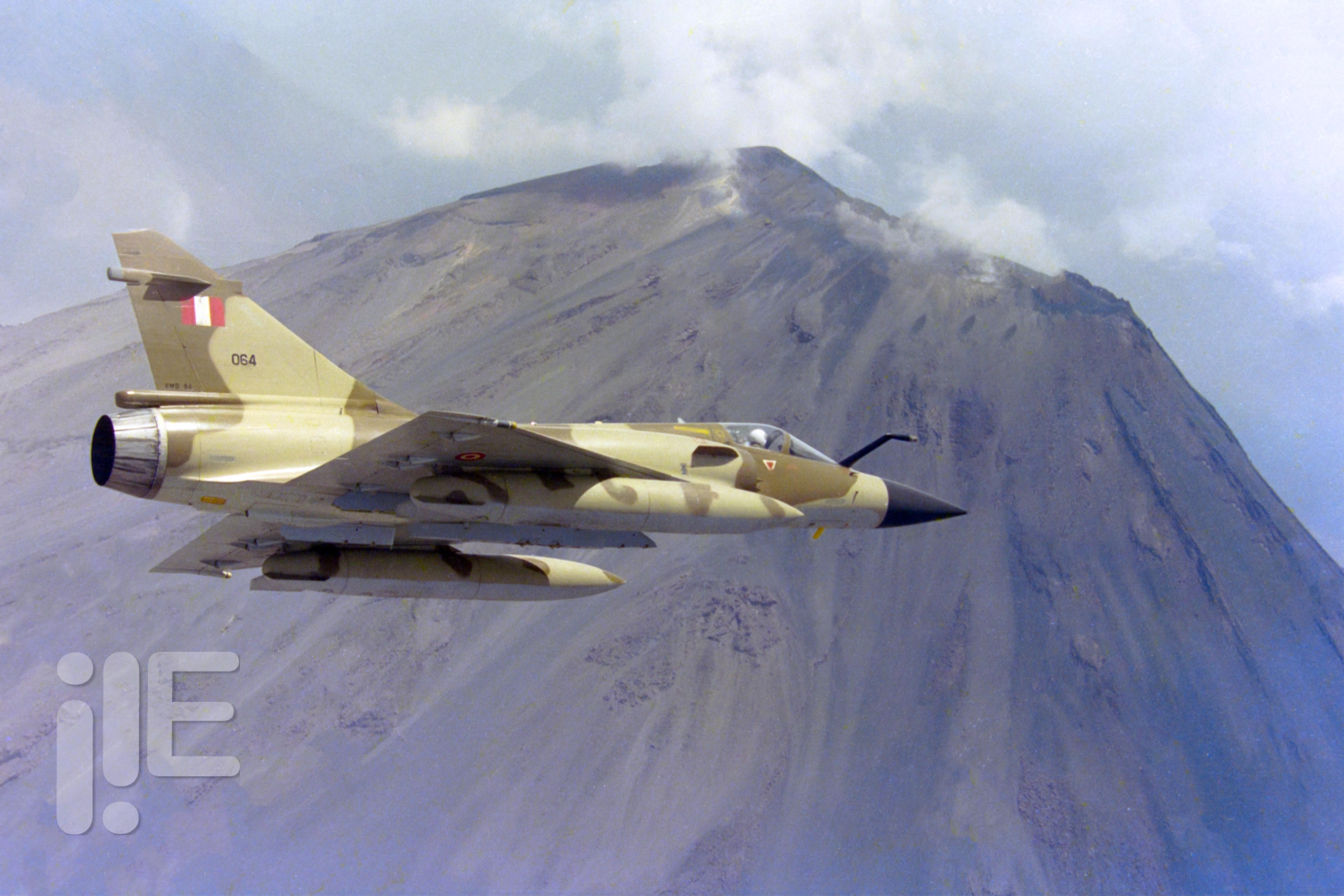
The Mirage 2000 aircraft is not only a beautiful and lethal aircraft, but also a complex platform, capable of launching a wide variety of and lethal weapons. But irresponsible politicians put Peruvian pilots in a difficult dilemma. I am grateful for having had the opportunity to experience the difficulties and dangers that pilots face, because experience is the ally of history.
This is just a brief and incomplete introduction to one of the most controversial episodes in our history, an episode hidden behind the fog of war and that will begin on January 26, 1995, with the deadly attack on the «Roosevelt» patrol, Peruvian soldiers who built a heliport in anticipation of the conflict that had been brewing for several weeks. The uncertain hours began, and the Armed Forces were pushed to fight in a surprising and unwanted conflict, for which they were not prepared.
This is the story of the ingenuity, courage and courage of Peruvian soldiers, aviators, sailors, policemen, huambisas[1]and businessmen, who joined forces to overcome shortages, difficulties and dangers in a territory that few knew, and that no government cared to take care of and for which they would later tear their clothes.
[1] Huambis, self-denomination of the indigenous nation that lives in the vicinity of the Santiago River and the Alto Cenepa.
 Home
Home 