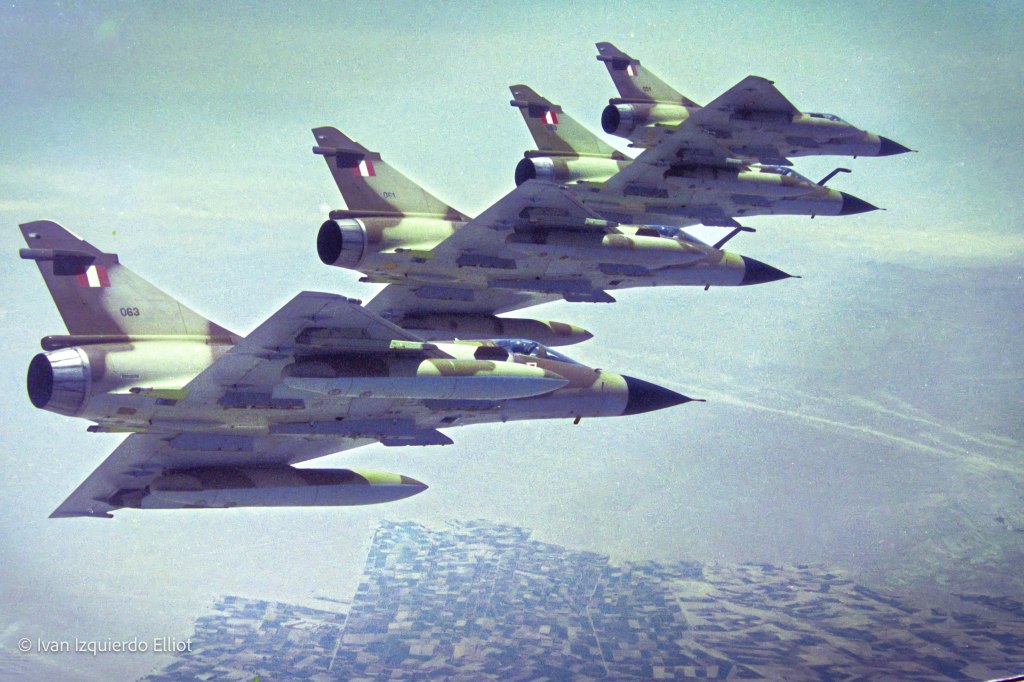
Some arguments against the need to renew military aeronautical equipment have some common sense, however, when analyzing the geopolitical context and the projections of powerful actors, economic, political and common-sense opinions prove to be insufficient. Here are arguments that support the need for the planned and controversial renewal of combat aircraft.
Factors Affecting the Creation and Modernization of an Air Force.
The Air Force has obsolete material of Soviet and Russian origin, not only because of its age, but because Vladimir Putin’s government has turned Russia into a pariah country in the West, making the acquisition of spare parts or the modernization of existing material impossible without throwing us into a political confrontation with the US and the EU. Geopolitically, Peru is in the middle of the Western political sphere, although Peruvian historical policies have always tried otherwise. This limits air stocks to a handful of French Mirage 2000 aircraft with 38 years of continuous use[1].
The renewal of air equipment involves a very long effort that begins before the acquisition of air equipment: planning stage, acquisition process (current), crew training, import of equipment, conditioning of infrastructure in air bases, maintenance system and management processes. The training of aircrews, support personnel and technical personnel (specialists in mechanical and electronic maintenance; weapons systems and air defense), demands thousands of hours of instruction, virtual training and hands-on training. It is estimated that, if the ideal conditions are in place (budgets, human talent and efficient public management), the creation of an air force can take up to ten years, which is why renovation plans must be started before the equipment in current use reaches its level of obsolescence. In the case of the Peruvian Air Force, obsolescence has come more quickly due to the Russian invasion of Ukraine and the economic and diplomatic sanctions on Russia. You cannot, and should not, buy from Russia.
Threat considerations: main reasons to build an air defense.
While regional powers do not constitute an immediate threat, intercontinental powers are in the immediate future. However, the capacity for deterrence in the Latin American neighborhood environment should not be lost since politicians and their ideologies change abruptly. For example, Javier Milei has made a complete turn in his geopolitical relations, distancing Argentina from the BRICS and strengthening the alliance with the United States and the West, correcting a geopolitical action inherited from the Kirchner regime. But political changes can be more dangerous, such as those of Nicolás Maduro’s regime in Venezuela threatening to invade Guyana. The South American neighborhood is always highly fickle.
Today a much more important geopolitical change is taking place, which has been altering the world dramatically: the accelerated growth of the BRICS[2] and the expansionism of China. Recently, several countries have joined this regional bloc in which Brazil wields a contradictory attitude towards the Americanist bloc. In August 2023, the economic bloc, BRICS, received new adhesions: Saudi Arabia, Iran, the United Arab Emirates, Egypt, Ethiopia and Argentina. The latter withdrew its association when Javier Milei took office. They are then formed by a coalition that in practice is not only economic but is also producing a geopolitical alignment of the members. The conflicts in Ukraine and Israel have been demonstrating the intentions of the countries of the bloc which, in short, is beginning to become a direct adversary of the US, NATO and the entire West.
China has the largest military fleet in the world, it has launched three aircraft carriers (it has officially announced the construction of five). China is aggressively expanding in the vicinity of the South China Sea, increasing tensions with Taiwan and mainly with the Philippines, countries allied with the US and potential cause of the outbreak of hostilities between the two powers. The confrontation of the powers at the economic, business, cyberspace, espionage, etc. level is no longer a secret. China and the United States are on a collision course. Chinese geopolitical expansionism includes the construction of overseas bases such as the Port of Piero (Greece), Djibouti on the Red Sea, considered the first military base outside Chinese soil; Gwadar (Pakistan), Bagamoyo (Tanzania), Hambantota (Sri Lanka) and Chancay (Peru), not to mention the dozens of ports that are managed by Chinese companies around the world. Ports, as well as other infrastructures, are of varied use, it can be for innocent trade or as support for war operations. China is a communist country (although some try to deny it), heir to imperialist ideas, of culture opposed to that of the West, where there is no respect for personal freedoms, opinion, human rights, high corruption and life with state secrecy. Communist China is a power with an iron fist in a deceptive silk glove. What is China’s goal in creating the means for its expansionism around the world and, above all, in the Pacific Ocean? Just securing its trade routes? China’s real intentions are virtually unfathomable and trusting them is a serious strategic mistake.
Political and international considerations that alter the status quo —and the world as we know it—.
Peru is a signatory to the TIAR, a hemispheric reciprocal defense treaty that ensures peace in the American continent, only altered by sporadic and limited hostilities between its members and an unusual and exceptional confrontation between Argentina and Great Britain. Peru finished defining all the borders, which put an end to regional controversies and therefore a peace was reached that has been lasting, the main argument against the renewal of equipment. But the world is moving towards a new world order and the emergence of new international threats that will require the formation of alliances and the ability to contribute to the defense of those alliances. It is unlikely to maintain a comfortable and indefinite neutrality during the rapidly approaching global conflict. Peru is an official ally of the United States. Joint military exercises are carried out such as those by the Air Force and the Navy. However, communist China has become the main trading partner and owns the many state-owned raw material extractive enterprises that directly contribute to its industrial and military effort. Now, China has been granted private property – illegal [3]– over the coastline and exclusive use of a mega port in Chancay. In practice, what is being granted to China it is a geopolitical enclave.
The U.S. Southern Command (SOUTHCOM) has been expressing concern about communist China’s expansionism in South America, the political influence it is gaining, and the literal «beachhead» as a potential strategic-military use in the future conflict.
What is Peru’s political strategy regarding international alliances? How will we be able to control the use that the Chinese want to give to the port of Chancay? Will we be able to prevent the military use of the port of Chancay? Will we continue to sell the raw materials to China that give it an advantage over our supposed Western allies? What would be the reaction of the US if the Chinese war fleet tried to use the port of Chancay? There are dozens more questions that will arise as these global events unfold but Peru could be selling its soul to the devil.
If the acquisition of air equipment is made considering interoperability with Western systems (NATO), then the military factor begins to define a strategy and geopolitical alignment, anticipating the undefinitions of the Foreign Ministry and the actual Government.
The cost of aircraft.
The approximate cost of new and state-of-the-art aerial systems is what has been advertised. The bidding process continues, but it has been contaminated by private interests and the «representatives» of the bidders, who are several.
Argentina has acquired 24 aircraft from Denmark at a cost of 301.2 million dollars. They date back to 1980 (44 years of use), and have been modernized, although this has limitations due to the technological changes of successive versions of the F-16. What has not been publicized is that they will have to acquire weapons from the U.S. (AMRAAM and AIM-9M missiles) for an additional cost of more than 300 million, to which must be added training, adaptation of infrastructure, acquisition of ground support equipment, spare parts, etc. The Argentine government has even had to access an FMF (Foreign Military Financing) subsidy provided by the U.S., the manufacturer of the system and weapons.
It could be said roughly that assembling the two squadrons could cost them between 900 and 1000 million dollars, but with a useful life horizon limited to about 10 or 15 years, which makes it equivalent cost to the Peruvian purchase claim, which is for new aircraft and with a life horizon of at least 40 years.
Corollary
The outer wall of the Ukrainian embassy in Lima displays a series of photographs showing the atrocities of the Russian invasion. They are accompanied by several legends, and one says: «Ukraine never imagined that in the 21st century it would be invaded by Russia.» The international rule of law and democracies are in danger on a planet that is rapidly moving towards a new obscurantism. Today, Ukraine desperately needs an air force.
The Peruvian ruling class, patrimonialist and salaried, is incapable of understanding the changes and anticipating the facts. The war with Chile demonstrated this and threw us into the worst moment in history, which can be repeated on a larger scale. How are we going to prepare for that moment which seems to be very close? To which geopolitical axis should we bow? Who will be our allies and who will be our enemies?
So far, in Perú nobody seems to know because everyone is roused praising the devil.
[1] Actually only eleven aircraft due to a tragic accident this year that ended what is perhaps the safest squadron operation in history.
[2] An economic and geopolitical bloc made up of Brazil, India, China and South Africa.
[3] Article 71 of the Political Constitution of Peru.
 Home
Home 