Mr. Smith comes to his office with the desire to know the world political, economic and financial events. He is responsible for managing a huge portfolio of clients and billions of dollars to be invested globally. The grey skyline of the City of London is the framework for his millionaire investments. The war between Ukraine and Russia, the overflowing military operations in Israel, the tensions in Asia due to Chinese expansionism and the constant eruptions of war in Africa, have been reducing the areas with investment opportunities. Latin America is always among their options; however, some countries have better results than others. He knows that the political factor is very important since Latin Americans have the habit of destroying each other.
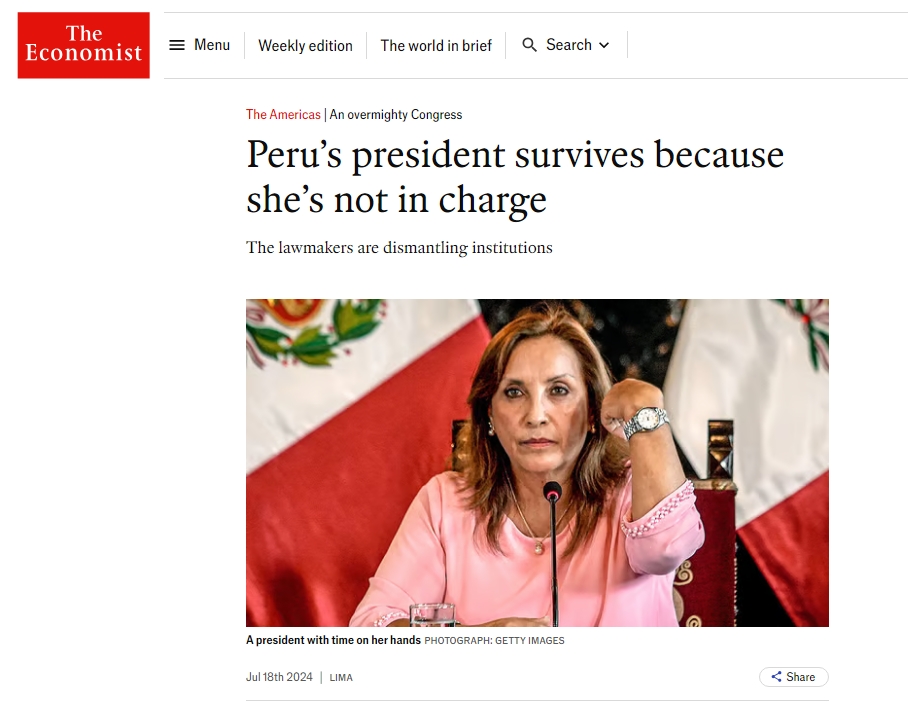
His company invests in the best strategic analyses that condense the most salient facts, it also has subscriptions to prestigious media such as Bloomberg, Business Week, TASC, Barron’s, Kiplinger’s, Wall Street Journal, Forbes, Financial Times and The Economist. The latter heads the pile of information that must be reviewed today. Smith begins to browse the magazine and comes across an article that catches his attention, it is about Peru, «Congress Rules[1]«. The headline alarms him because the day before his collaborators had recommended a significant investment in the Andean country. He is no stranger to Dina Boluarte’s political problems, the precariousness of her government or the financial risk that Peruvian politics represents. The subtitle catches his attention even more: «Lawmakers are dismantling institutions”. This is serious. Smith arrives at a very important paragraph that reflects the interests of legislators and the future of the country:
«Congress repealed a law to curb illegal mining, neutralized a body charged with regulating for-profit colleges that serve the poorest students, and allowed thousands of teachers, who failed basic exams, to return to the classroom.»[2]
Assholes, they don’t care about the future of the country or the health of the companies that invest millions in mining, Smith thinks, ignorance is daring. Who wrote this? — he realizes that it’s an editorial article — Fuck! — Continue with the worrying reading:
«One of the decisions [of the Constitutional Court] has allowed Congress to initiate new spending measures, which the Constitution itself prohibits. That is bad for Peru’s fiscal credibility that cost him so much to earn. Lawmakers have approved nearly 50 billion soles ($13 billion) in extrabudgetary spending so far, according to the fiscal council, an official advisory body. In the past, the Chancellor of the Exchequer tended to restrict the populist whims of lawmakers, but he was silent as Congress granted bonuses to pensioners and judges, crafted regressive tax breaks, and ignored his own limit on the fiscal deficit.»[3]
Wow, things are going to get bad if they keep spending money like this,» he frets. Read the sentence of the former Minister of Economy Alonso Segura: «There is no longer an adult in the room». He can’t help but smile. At this point, his options to invest in Peru are beginning to falter: «Well, will it be possible to leave Peru for future investments?» Smith wonders as he continues reading.
«Many Peruvians hope that the next elections, scheduled for 2026, will bring better leadership. The omens are not good. More than 30 parties plan to participate. Improbably, Mr. Fujimori, who is 85, says he plans to run again. And the next president will face an empowered Congress.»[4]
Smith closes the magazine, approaches the phone and communicates with the person in charge of the portfolio: «Peru is fucking out!«.
[1] The Economist. Print edition of July 20, 2024.
[2] The Economist. Peru ́s president survives because she ́s not in charge. July 18th, 2024.
[3] Ditto 2
[4] Ditto 2
 Home
Home 